RN & LPN and hypnotherapy lanes
Hypnosis for Pain Management Certification (4th Edition)
 Course author and presenter Capt. M. Ron Eslinger, CRNA
20 hours of instruction on using hypnosis to manage chronic and procedural pain — the biology behind it, how to assess a patient’s response, how to build suggestions for one person rather than a script, and the protocols for the presentations you meet most. It is carried by the recorded sessions themselves: eleven of them, 21 hours 28 minutes.
$299 $14.95 per contact hour
One course, one price, in both lanes: $299 covers the twenty contact hours, the exam and the certificate.
 RN & LPN
21 h 28 min recorded
- Contact hours
- 20For registered and licensed practical nurses
- Instruction time
- 20 hoursSelf-paced, taken over as many sittings as you like
- Recorded video
- 21 h 28 min11 sessions, about 21.5 hours in total
- Exam
- Online100 randomized questions, 80% or better. Unlimited attempts.
- Certificate
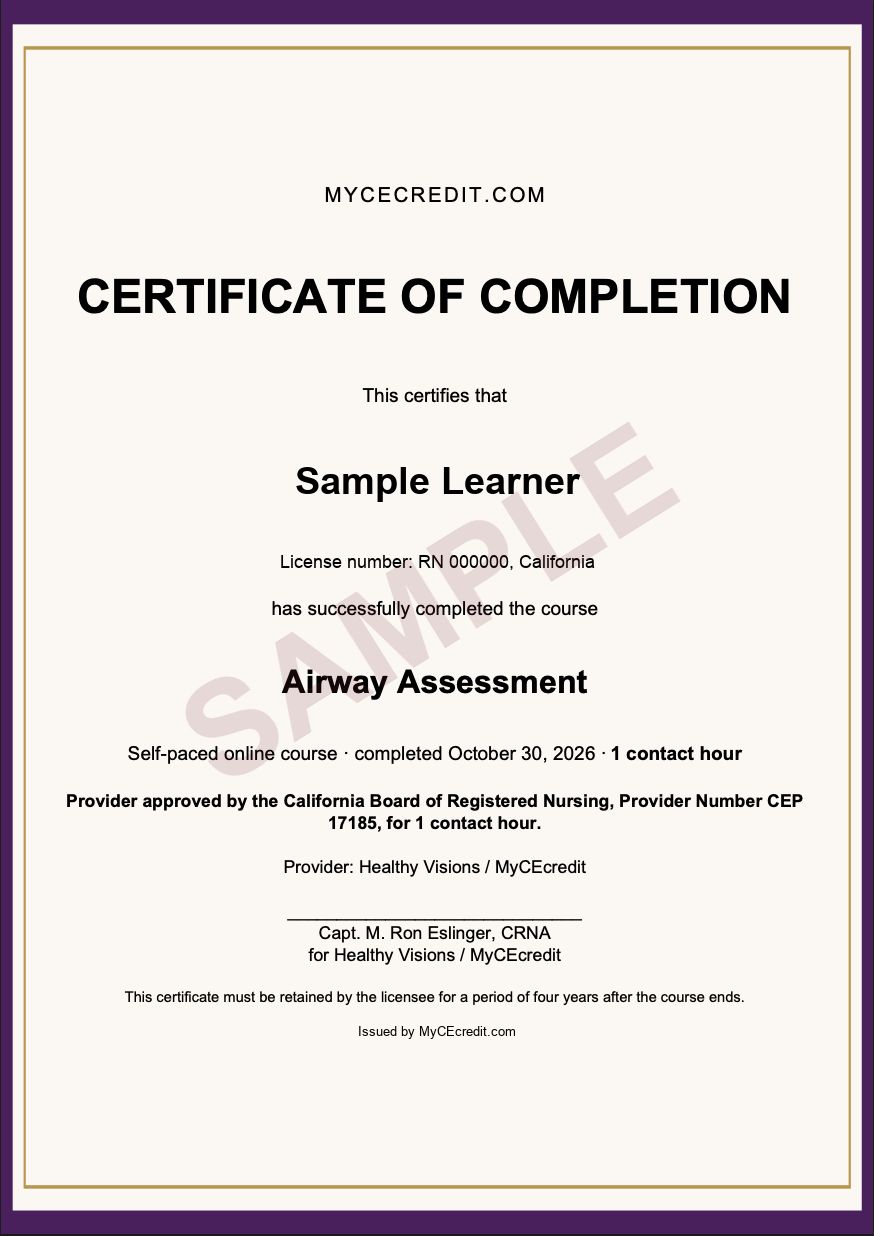
- On completionDownloadable from your account
Learning objectives
What you will be able to do
Twenty-four stated objectives, one set for the eleven lectures. They run from the physiology through to the protocols, which is why the course runs to 20 hours rather than the 1 to 1.5 you will find elsewhere in this lane.
- Review the brain’s response to emotion and suggestion.
- List 5 techniques for overcoming client/patient resistance to suggestions.
- Identify eight brain mechanisms that are most responsive to hypnosis for pain management.
- List and discuss 3 types of pain.
- List 4 experiences in multifactorial pain.
- List and discuss 5 benefits of hypnosis in pain management.
- List 10 questions that help rate a person’s hypnotizability.
- Identify 2 hypnotic convincers.
- Name 3 categories for describing pain sensations.
- Describe the use of metaphors in hypnotic suggestions.
- Develop introductory phrases for patient suggestions.
- Discuss the use of glove anesthesia/analgesia.
- List at least 5 coping skills using hypnosis in pain management.
- List two CRNA verbal techniques for pre-op and post-op anesthesia care that decrease pain and anxiety.
- Describe a hypnotic technique for headache relief.
- Compare a person’s physical strength related to positive and negative thoughts.
- List the physical, emotional and behavioral components of stress in chronic pain.
- Discuss biological and physiological responses to thought.
- Identify a person’s dominant sense and its importance in suggestive communication.
- Demonstrate the Harvard raisin mindfulness technique.
- Discuss the effect of alpha tones and white light on pain and stress.
- Describe right/left-brain stimulation to manage chronic pain.
- Describe the steps of glove-anesthesia induction.
- Describe the three steps of self-hypnosis.
Course outline
Eleven recorded sessions
The course is the recording of the full program itself, session by session, with the full runtime of each one shown before you buy. Nothing here is a five-minute clip padded out to an hour.
- 01 The brain, emotion and suggestion 96 min
- 02 Brain mechanisms of pain and the three types of pain 116 min
- 03 The multifactorial pain experience and the benefits of hypnosis 94 min
- 04 Session structure, hypnotizability, convincers and describing pain 149 min
- 05 Metaphors and phrasing suggestions 119 min
- 06 Glove anesthesia and coping skills 95 min
- 07 Perioperative suggestion, headache relief, and thought and strength 157 min
- 08 Stress, the body’s response to thought, and the dominant sense 162 min
- 09 Mindfulness, alpha tones and white light 116 min
- 10 Right/left-brain stimulation, glove anesthesia induction and self-hypnosis 145 min
- 11 Suggestion and patient sedation 40 min
Runtimes are the real length of each recording, rounded to the nearest minute. Total 21 h 28 min assessed as 20 contact hours.
What you actually get
The recordings behind the hours
Most online CE is a PDF with a quiz stapled to it. This one is the full program on video, and the numbers are on the page before you spend anything.
The recorded sessions
Eleven recorded sessions, 21 h 28 min, running from the physiology through assessment, induction and protocol. This is the spine of the course and it is what the 20 contact hours are assessed against.
Sessions, not clips
The shortest session in the course runs 40 minutes; the longest runs 162. Seven of the eleven are over 115 minutes. Every runtime is listed against its module in the outline above.
How the video is delivered
Sessions stream inside the course; there is nothing to download and nothing to install.
Who it is for
For nurses and hypnotherapists who work with pain
This is written for registered and licensed practical nurses who work with patients in chronic pain, or who prepare and recover patients around a procedure. It assumes clinical experience and no prior hypnosis training: objective one is the biology, and the induction work is built up from there.
Hypnotherapists take the same course at the same price, and it is listed with our hypnotherapy courses. The 20 contact hours are for nurses.
It is a long course by the standards of the rest of this catalog — 20 hours against the 1 to 1.5 the rest of the lane runs. It is the right one if you want the whole method rather than an hour on a single topic, and the wrong one if you have a renewal deadline this week.
Continuing education
The statement for this course
Continuing-education approval
Provider approved by the California Board of Registered Nursing, Provider Number CEP 17185, for 20 contact hours.
No outside financial support.
This statement applies to this course only. Requirements differ by state, license type and renewal cycle — check your own board’s current language before you enroll.
How it works
Four steps, start to certificate
- Step 1 Enroll
- Step 2 Work through the sessions online
- Step 3 Pass the exam, complete the evaluation
- Step 4 Download your certificate
Everything happens in your browser. Progress is saved as you go, so 20 hours does not have to be one sitting, and the certificate stays in your account once you have earned it.
Before you add it to the cart
Five questions worth asking first
What does “Certification” in the title mean?
It is the course’s name, carried over from its fourth edition. On completion you receive a certificate of completion for this course. It is not a license, a credential or an endorsement issued by any board, and it does not change what the continuing-education statement above says.
Will these 20 hours count toward my license renewal?
The continuing-education statement above applies to this course and to nothing else. Requirements differ by state, license type and renewal cycle, so read it against your own board’s current language before you enroll.
Where we do not hold written confirmation from a board, we print that on the page rather than implying acceptance. You will see that on our Michigan page, and it works the same way here. Whether these hours meet Michigan’s pain requirement is not yet confirmed in writing by the Michigan Board of Nursing.
What is actually in the course?
Eleven recorded sessions totalling 21 h 28 min, assessed as 20 contact hours — the outline above lists every session with its real runtime.
How long does it take, and how do I get the certificate?
20 hours of instruction, online and self-paced. Progress is saved, so most people take it across several sittings. Complete the sessions and the short implicit-bias reading, pass the exam, complete the short evaluation, and the certificate is in your account to download.
Access period and refund terms are set out in our policies.
What does the price include?
The $299 fee covers the eleven recorded sessions, the slides and manual, the exam and the certificate of completion. There is no separate exam fee and no charge to download the certificate.
Need shorter courses as well?
Six more RN & LPN courses, 1 to 1.5 contact hours each, from $12.